

 Current position > News detail
『Wedge Flow meter 』Related information(flow rotameter|digital flow meter|balo meter|hydraulic flow meter|volumetric meter|positive displacement meter|pitot tube flow meter|displacement meter|cfm meter|variable area flow meter|inline flow meter|differential pressure flow meter|calibrated flow meter|velocity meter|paddle wheel flow meter|oval gear flow meter|anemometer hvac|multiphase flow meter|doppler flow meter|thorpe tube flowmeter|heat flow meter)
Why cant a globe valve be directly installed on the front end of a wedge-shaped flowmeter? Wedge flowmeter is a flowmeter that utilizes the principle of conversion between dynamic pressure energy and static pressure energy: (throttling type) In the same closed pipeline, when the fluid flows rapidly and the velocity increases, its static pressure energy will be converted into dynamic pressure energy. So in the same closed pipeline, the higher the flow velocity, the lower the static pressure. By installing a throttling element in the fluid pathway to increase the flow rate of the fluid passing through it, a static pressure zone with different pressures will be formed before and after the throttling element. The square of the pressure difference (differential pressure) is proportional to the flow rate. By measuring the differential pressure and taking the square root, the flow rate value can be obtained. The throttling element of a wedge flowmeter is a wedge-shaped protrusion on the pipe wall, and the flow rate can be determined by measuring the pressure difference before and after the protrusion when the fluid passes through it. Due to the relationship between differential pressure and flow rate being obtained through experiments and calculations on the basis of a straight pipe section, its parameters are determined based on the fluid flow characteristics in the straight pipe. Installing elbows, tees, valves, insertion components, etc. at the front end of the flowmeter will affect the flow characteristics of the fluid, so a certain amount of straight pipe section must be left. The length of the straight pipe section of a wedge-shaped flowmeter is generally 5-20 diameter lengths, which can be found in the flowmeter manu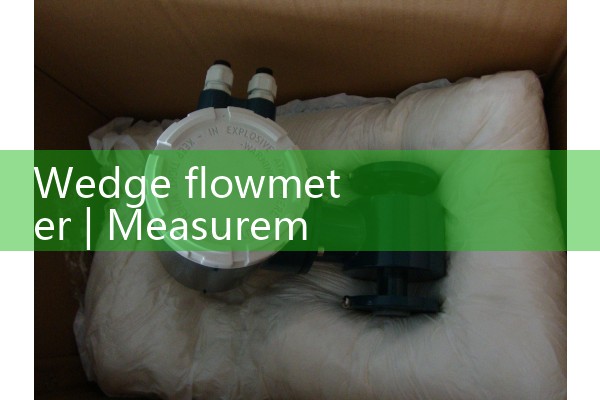
2. Measurement principle of wedge-shaped flowmeter
When the fluid passes through the beam dynamic wedge-shaped flowmeter, the wedge-shaped structure plays a key throttling role.
. This throttling process results in a pressure difference on the upstream and downstream sides of the flowmeter that has a square relationship with the actual flow rate. This pressure difference is cleverly introduced from the pressure taps on both sides. These differential pressure signals are then sent to the differential pressure transmitter, which converts them into electrical signals for output. Furthermore, these electrical signals are processed and calculated by specially designed intelligent flow integrators, and ultimately, we can obtain flow values from these tedious mathematical relationships. The flow calculation formula of a wedge flowmeter is based on the following formula: qv=C * ε * π * D ^ 2 * (2 * Δ P)/(1-m ^ 2/4 * ρ), where qv represents the flow rate of the fluid, measured in cubic meters per second (m3/s). The outflow coefficient C and the expansion coefficient ε are important parameters that affect flow rate. The ratio m (S1/D) of the opening area of the pressure port to the inner diameter of the pipeline can also affect the measurement results. Δ P represents the pressure difference, measured in pascals (Pa), while ρ represents the density of the measured medium, measured in kilograms per cubic meter (kg/m3). This formula reflects how flow meters convert pressure changes into actual flow values through physical phenomena and mathematical models. The extended data wedge flowmeter is a new type of flowmeter that began to gradually move towards practicality in the 1980s. Its detection component is a V-sh